How Does the 2026 Ford Bronco Sport Compare to the F-150?
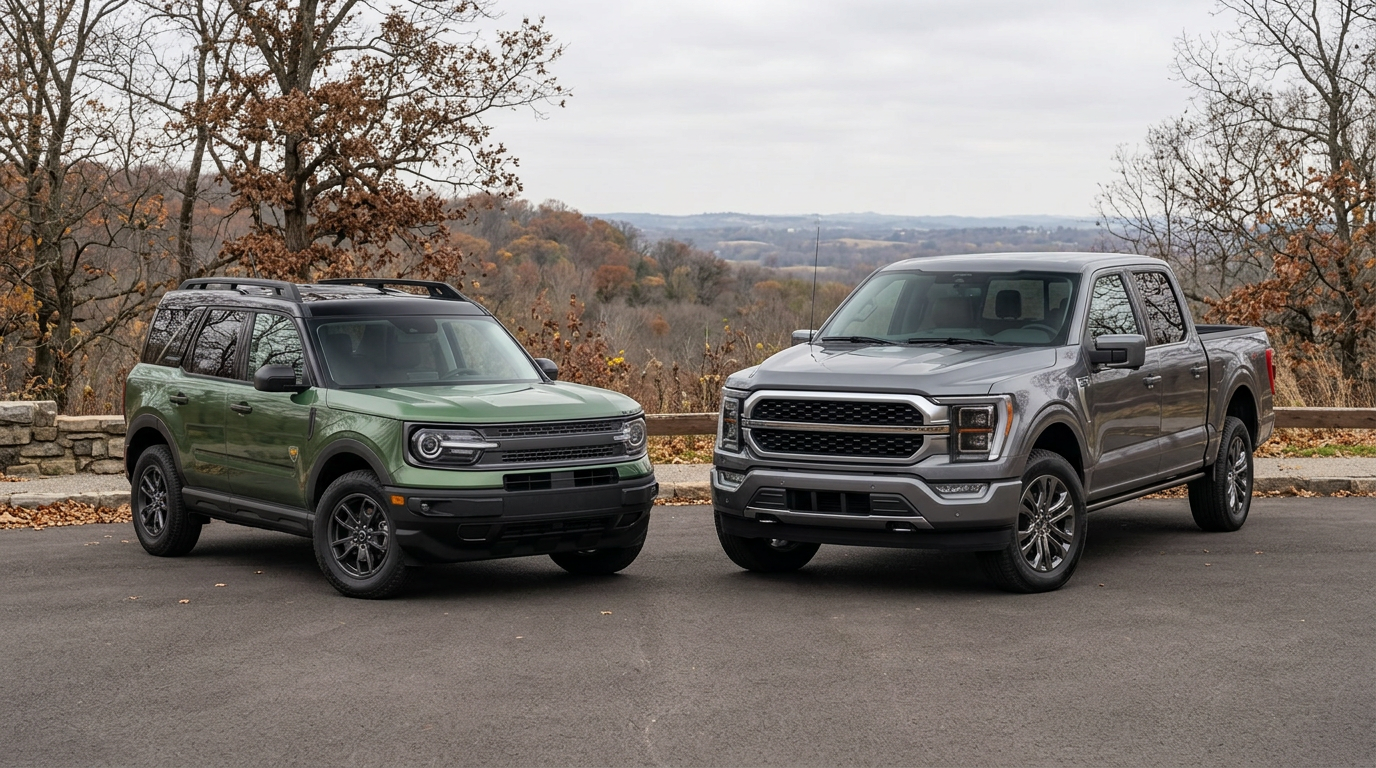 The 2026 Ford Bronco Sport is an agile compact SUV built on a car-like unibody platform that prioritizes maneuverability, standard all-wheel drive, and everyday fuel economy, while the 2026 Ford F-150 is a full-size, body-on-frame truck designed for heavy commercial towing, open-bed hauling, and immense passenger volume. Choosing between them comes down to whether your routine requires an enclosed, easy-to-park adventure vehicle or a full-size workhorse capable of pulling large trailers and seating up to six.
The 2026 Bronco Sport seats up to five passengers and comes standard with four-wheel drive across all trims, making it a nimble choice for navigating tight parking areas and daily suburban errands around Blue Springs. It features a unibody construction shared with compact crossovers, delivering responsive road manners and a comfortable ride over everyday pavement.
The 2026 Ford F-150 utilizes a high-strength, military-grade aluminum-alloy body mounted on a fully boxed steel frame. Ford offers it in Regular Cab, SuperCab, and SuperCrew configurations, providing versatile bed lengths and seating configurations for work crews or large families. While the Bronco Sport measures roughly 173 inches in length, a typical F-150 SuperCrew spans over 230 inches, representing a significantly larger footprint in the driveway and on the road.
If you want to compare both vehicle footprints side by side, view our showroom location to plan your visit, or call our sales staff at (816) 229-4400 for inventory updates.
Table of Contents
- Towing Capacity and Trailering: How Much Can the Bronco Sport Tow Compared to the F-150?
- Cabin Space, Rear Legroom, and Cargo Utility: Compact SUV vs. Full-Size Truck
- Fuel Economy, Octane Needs, and Driving Range: Does the Bronco Sport Require Premium Gas?
- Drivetrain Comparison: Does the Bronco Sport Feature True 4WD with Low Range?
- Value Sweet Spots: Which Trims Offer the Best Balance for Buyers?
- Common Questions About Choosing Between the Bronco Sport and F-150
- Experience the Bronco Sport and F-150 at Blue Springs Ford
Towing Capacity and Trailering: How Much Can the Bronco Sport Tow Compared to the F-150?
The 2026 Ford F-150 pulls up to 13,500 pounds of conventional towing and handles up to 2,440 pounds of payload when properly equipped, completely outclassing the 2026 Bronco Sport’s maximum towing capacity of 2,700 pounds. Shoppers requiring the muscle to pull multi-horse trailers, large travel campers, or heavy equipment skids will find the capability they need exclusively in the full-size truck platform.
The 2026 Bronco Sport handles lighter recreational hauling with ease. Base models powered by the 1.5L EcoBoost three-cylinder engine offer a towing capacity of 2,200 pounds. Upgrading to the Badlands trim with the 2.0L EcoBoost four-cylinder elevates that rating to 2,700 pounds. This proves sufficient for small teardrop campers, pop-up camping trailers, jet skis, or lightweight utility trailers carrying yard supplies.
The F-150 caters to serious trailering demands with multiple powertrain choices:
- 2.7L EcoBoost V6: Delivers 325 hp for solid mid-tier trailer capability.
- 5.0L V8: Provides traditional naturally aspirated V8 performance with 400 hp.
- 3.5L EcoBoost V6: Produces 400 hp and unlocks the maximum 13,500 pounds tow rating.
- 3.5L PowerBoost hybrid: Generates 420 hp while integrating the mobile power generation of Pro Power Onboard.
Advanced driver-assist features on the truck, such as Pro Trailer Backup Assist, make reversing a loaded trailer intuitive using an integrated dash dial. Shoppers interested in exploring capable pre-owned trucks or trailering SUVs can evaluate our current pre-owned vehicle selection to see various configurations currently available.
Cabin Space, Rear Legroom, and Cargo Utility: Compact SUV vs. Full-Size Truck
The 2026 F-150 SuperCrew provides an expansive 43.6 inches of rear legroom alongside an open cargo box, whereas the 2026 Bronco Sport offers 36.9 inches of second-row legroom and up to about 65 cubic feet of weather-protected, enclosed cargo volume. For growing families needing car-seat clearance, the full-size truck cabin functions as an expansive mobile living space, while the compact SUV provides lockable, weatherproof storage directly behind its passenger rows.
In the Bronco Sport, utility centers around practical storage solutions. Models equipped with the 1.5L EcoBoost engine supply about 32.5 cubic feet of cargo space behind the second row and expand to about 65 cubic feet when the 60/40 rear seat folds forward. Selecting the 2.0L EcoBoost slightly adjusts cargo space to about 29 cubic feet behind row two and about 61 cubic feet behind row one. The safari-style roof provides upright clearance that easily fits bicycles standing upright, and the flip-up rear glass hatch allows quick loading without swinging open the entire liftgate.
The F-150 takes a different approach by dividing dry interior volume and heavy-duty exterior utility:
- SuperCrew Rear Row: Features a completely flat load floor when the split bench seat folds upright, creating enough protected space for large tool cases, camping bins, or family pets.
- Truck Bed Versatility: Offers 5.5-foot, 6.5-foot, and 8-foot beds to handle bulk gravel, drywall sheets, and oversized recreational equipment that no SUV interior could accommodate.
- Interior Workspace: Available stowable shifters allow the center console to transform into a wide desk surface suitable for laptops and paperwork.
For active households packing paddleboards for outings near Lake Remembrance in Blue Springs, the Bronco Sport's enclosed hold keeps sports bags secure and clean, whereas heavy landscape materials clearly demand the F-150’s open bed.
Fuel Economy, Octane Needs, and Driving Range: Does the Bronco Sport Require Premium Gas?
The 2026 Ford Bronco Sport does not require premium gasoline, running smoothly on regular 87-octane unleaded fuel across its entire lineup. Ford calibrates both the 1.5L EcoBoost and the 2.0L EcoBoost engines to operate reliably on standard fuel, though filling the 2.0-liter engine with 93-octane premium unleaded unlocks its peak factory output of 250 hp and 280 lb-ft of torque for responsive passing power.
Fuel efficiency ratings establish a decisive separation between the two vehicles:
- Bronco Sport 1.5L EcoBoost: Delivers an EPA-estimated 25 city/30 highway mpg with standard all-wheel drive.
- Bronco Sport 2.0L EcoBoost: Returns an EPA-estimated 21 city/27 highway mpg.
- F-150 3.5L PowerBoost Hybrid: Reaches up to 24 mpg combined, providing competitive efficiency among full-size pickups.
- F-150 Gasoline V6 & V8 Options: Typically achieve roughly 17 to 20 mpg city and 24 to 25 mpg highway in common configurations.
Driving range reveals another distinct functional split. The Bronco Sport carries a 16-gallon fuel tank, yielding roughly 400 to 430 miles of mixed range between stops. In contrast, an F-150 fitted with the available 36-gallon extended-range fuel tank can travel between 700 and 800 highway miles on a single fill-up, minimizing fuel stops during long cross-state hauls.
Drivetrain Comparison: Does the Bronco Sport Feature True 4WD with Low Range?
Ford pairs the 2026 Bronco Sport’s intelligent all-wheel-drive system with G.O.A.T. Modes, rather than a traditional two-speed transfer case with dedicated low range. Modes (Goes Over Any Type of Terrain). By contrast, four-wheel-drive configurations of the 2026 F-150 use a heavy-duty, selectable four-wheel-drive system complete with mechanical 4-Low gearing for maximum low-speed crawl control.
Every Bronco Sport comes equipped with standard all-wheel-drive capability designed to divert torque instantly between the front and rear axles. Base trims use a single clutch pack at the rear axle, whereas the off-road-focused Badlands trim features an advanced twin-clutch rear-drive unit with a physical differential lock. This setup simulates a mechanical locker by vectoring 100 percent of available rear-axle torque to either individual wheel when traction vanishes in slick ruts or snow.
The F-150 employs traditional truck four-wheel drive built on an independent transfer case:
- 2-High (2H): Directs 100 percent of drive power to the rear wheels for optimal highway efficiency.
- 4-High (4H): Mechanically locks front and rear driveshafts to distribute power equally over sand, deep snow, or mud.
- 4-Low (4L): Multiplies low-end torque through gear reduction, allowing the truck to pull boats up slick launch ramps or negotiate steep, rocky grades without overheating the transmission.
- Electronic Locking Rear Differential: Available across most F-150 trims to lock both rear wheels together at the touch of a button.
On snow-packed suburban routes around Lee's Summit, the automatic engagement of the Bronco Sport AWD system delivers immediate confidence without driver intervention, while demanding job sites benefit from the low-speed mechanical multiplication of the F-150.
Value Sweet Spots: Which Trims Offer the Best Balance for Buyers?
The best overall value in the compact SUV lineup is the Bronco Sport Outer Banks, which combines premium interior amenities with efficient performance, while the sweet spot in the full-size truck lineup is the F-150 XLT SuperCrew equipped with mid-level comfort packages. Both of these mid-range selections avoid entry-level work-truck austerity while delivering modern convenience and strong long-term resale value.
The Bronco Sport lineup ranges from the entry Big Bend up through the rugged Badlands:
- Big Bend: Provides standard all-wheel drive, durable cloth seating, and modern driver-assist features.
- Outer Banks: Adds heated leather-trimmed seating, dual-zone automatic climate control, 18-inch aluminum wheels, and a modern digital gauge display.
- Badlands: Focuses purely on capability, adding the 2.0L EcoBoost engine, raised suspension dampers, underbody steel skid plates, and the twin-clutch rear drive unit.
The F-150 spans a wide spectrum from the utilitarian XL and stylish STX to the opulent King Ranch and Platinum:
- XLT: Introduces chrome or black exterior trim enhancements, carpeted flooring, Ford Co-Pilot360 safety technology, and expanded access to popular trailering packages.
- Lariat: Steps up to leather seating, ventilated front buckets, and advanced in-cabin connectivity.
- Tremor: Introduces trail-tuned shocks, all-terrain tires, and dedicated mechanical skid plates for off-road work sites.
Shoppers can explore our inventory of the new 2026 Ford Bronco Sport to compare trim packaging in person. When preparing your budget, our team can help you appraise your trade-in and assist as you contact us about financing options online to streamline your showroom experience.
Common Questions About Choosing Between the Bronco Sport and F-150
Q: Can the Bronco Sport pull a pop-up camper or small boat?
The 2026 Bronco Sport can comfortably pull lightweight pop-up campers, small utility trailers, and single personal watercraft. Models with the 1.5L EcoBoost carry a 2,200-pound towing limit, while the Badlands trim with the 2.0L EcoBoost tows up to 2,700 pounds. Owners must ensure the fully loaded trailer weight, including gear and fluids, remains within these certified factory limits.
Q: Does the F-150 fit inside standard residential home garages?
A standard 2026 F-150 SuperCrew with a 5.5-foot bed measures approximately 232 inches in total length, which requires at least 20 feet of clear garage depth to park indoors. Many suburban two-car garages measure between 20 and 22 feet deep, leaving minimal clearance around the bumpers. In contrast, the Bronco Sport measures roughly 173 inches long, parking easily in virtually any residential garage with ample room to spare.
Q: Which vehicle provides a softer, quieter daily ride on broken pavement?
The Bronco Sport delivers a more car-like, compliant ride across broken suburban pavement thanks to its fully independent four-wheel suspension and unibody architecture. The F-150 provides a remarkably refined cabin and modern steering response, but its solid rear axle and leaf-spring rear suspension can transmit slight bed hop over consecutive road seams when the cargo bed carries no weight.
Q: What warranty coverage comes standard with these Ford models?
Both the 2026 Ford Bronco Sport and the 2026 Ford F-150 include Ford's standard new-vehicle factory limited warranty. This package covers three years or 36,000 miles of bumper-to-bumper protection and five years or 60,000 miles of powertrain coverage. If you want to learn more about our dealership’s customer-first philosophy, take a moment to read our background before stopping in.
Experience the Bronco Sport and F-150 at Blue Springs Ford
Whether your daily drive calls for the nimble, fuel-efficient capability of the 2026 Bronco Sport or the commanding payload and towing capacity of the 2026 F-150, our showroom offers a diverse inventory of configurations to test drive. Compare cabin dimensions, assess driving sightlines, and explore current financing options tailored to your household goals. Plan your test drive by finding our dealership address on the map, or speak directly with our team at (816) 229-4400 today.
Keep Your Vehicle Running Strong
Keep your vehicle performing at its best with our expert team:
© 2026 Blue Springs Ford. All rights reserved.